Luke Beal News

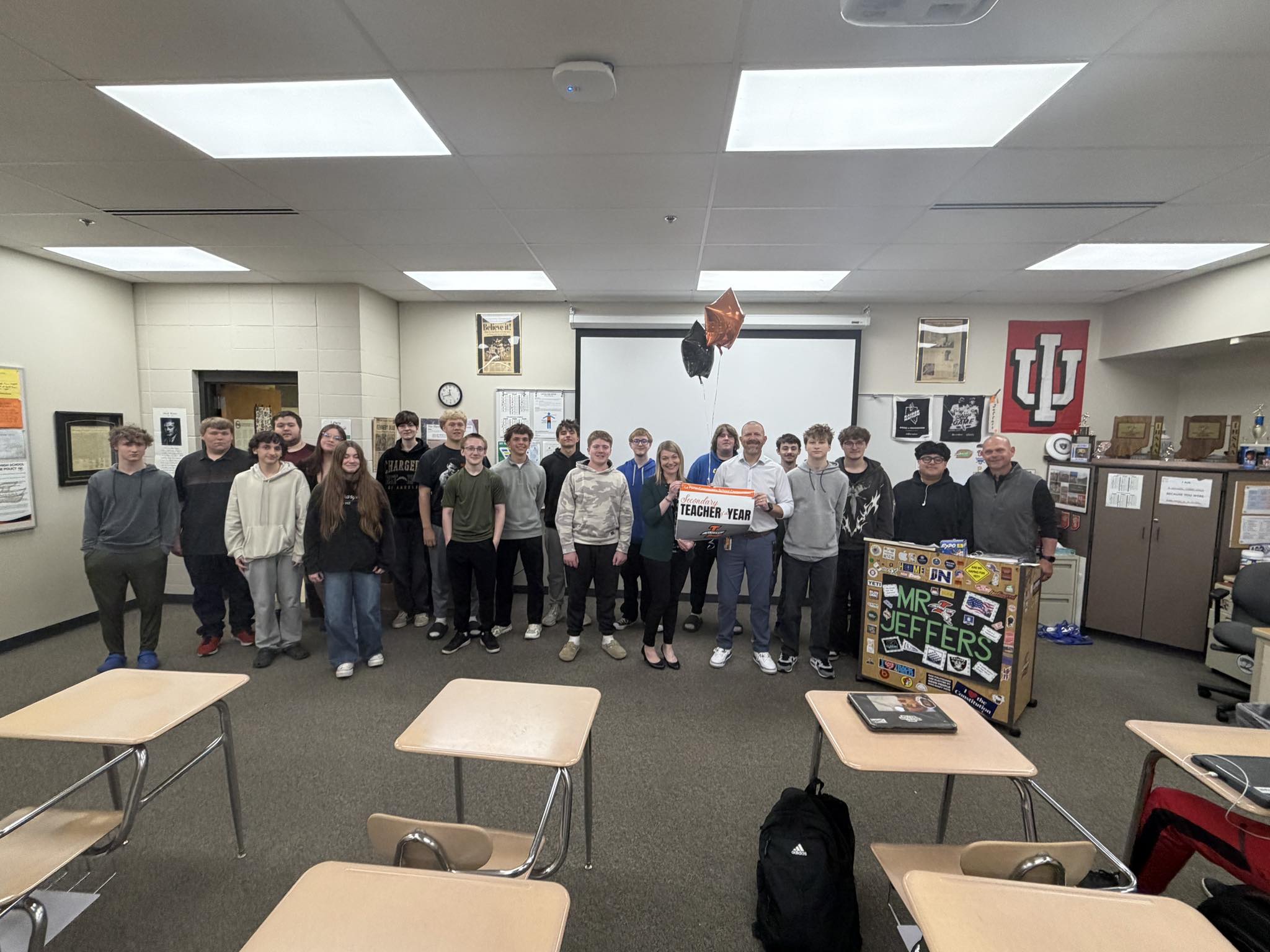
Mr. Dan Jeffers was named secondary teacher of the year for LPCSC.
Jeffers has been teaching for 25 years, earning a bachelor's in 2001 and a master's degree in 2006, both from Indiana University.
Jeffers has taught AP and on-level Psychology, social studies, AP and on-level Government, and Indiana Studies for the past few years.
When Jeffers teaches, he tries to gain and hold his students' attention in various ways.
“For any topic I cover in any of my classes, I try to accomplish two things: 1. I try to make the topic relevant to the students and 2. Find a way for students to engage in the content in one way or another. This can be accomplished, depending on the subject through exploration and research, lab activities in psychology, or other ‘hands on’ activities that make the subject both relevant and meaningful,” Jeffers said.
With Jeffers teaching a handful of classes, he's bound to have lessons from different classes he likes more than others.
“I would have to lean more towards my Psychology activities and labs. It gets kids out of their seats, experiments with content, and tracks data related to what we've been discussing in class. I have activities for sensation and perception, depth perception, creativity, development, stress and health, and other topics related to psychology content,” Jeffers said.
Jeffers has watched many major and minor changes in the school over the years.
“I have noticed students overly relying on technology to get by. Anyone can Google something, but if we don't do our own due diligence to research and understand topics and concepts ourselves, we will be forced to rely only on what information is provided to us from that technology, and we will have no way to vet what you've been given,” Jeffers said.
Jeffers has some knowledge and advice to share with both current and future teachers.
“Never stop learning and evolving as an educator. I reevaluate what I have done with students and try to improve it to make it more relevant, engaging, and/or efficient every year. I would also highly encourage them to reach out to other teachers here at LPHS or any building they are working in. We have some absolutely brilliant teachers here at LPHS, and we would all benefit from getting their insight from time to time,” Jeffers said.
Jeffers is an example of an amazing teacher at LPHS, with engaging lessons and connections to the lesson material that many strive to achieve. He now moves on to compete for the title of Indiana Teacher of the Year. Congratulations to Mr. Jeffers!
.jpg)
The La Porte High School Speech team has performed exceptionally well this year under the direction of Mr. Stewart.
Stewart has led the speech team to compete in tournaments all over the northern half of the state this season, from as far west as Bishop Noll in Hammond and as far east as Concord High School in Elkhart.
“This is my fourth year as head coach of the Speech Team. I have been involved with the LPHS Speech Team for many years—as a student, I was on the team for all four years of high school here at LPHS. I am so pleased to say that we have enjoyed more success each year of my tenure as head coach!” Stewart said.
Competitions begin at 8:30 in the morning and end around late morning to early afternoon, with the pre-season competitions running from November to winter break, and then official seasons starting in January with Sectional and District competitions in February or March.
The Speech team has had some exciting highlights from the competitions this year.
“This has been our best season since I have been the head coach of the Speech team. This year, we registered five competitors for Sectionals and two for Districts; we had three State qualifiers and one State quarterfinalist!” Stewart said.
Not only did LPHS have five competitors, but they performed well, too, compared to previous times.
“Our biggest team success lately has been placing fifth as a team at Sectionals. My first year as head coach, we didn’t even have anyone compete, so the fact that we not only had five competitors, but that they did so well in competition as to rank at Sectionals, was a great achievement!” Stewart said.
However, these achievements did not come so easily for both Stewart and for the team.
“Compared to many other schools in our section and district, our speech team has many fewer members and much less funding than other programs. The fact that we make up in quality what we may lack in sheer numbers is a great source of pride for us! Additionally, I know full well that talented students are frequently involved in more than one activity, so scheduling can sometimes be a challenge. I am highly committed to the idea that competing with the LPHS Speech Team should never be a barrier to other involvement at LPHS!” Steward said.
Stewart has expressed that he is extremely proud of everyone on the team, but he expressed his appreciation for a few students in particular.
We had several notable students this year including Elizabeth Shaffer who served as President of the Speech and Debate Society this year and competed valiantly in Impromptu Speaking, John Schymanoske learning Extemporaneous Speaking and taking it all the way to the District Competition in March, and Lucy Whicker who also learned Discussion this year, and not only qualified for State competition, but advanced all the way to the Quarterfinal round, placing her within the top 24 competitors in the entire state.
“Finally, Halyn Pumroy continued the winning streak she began last year as a Freshman, regularly double-entering at competitions and invariably placing in both events, if not winning at least one of them. Halyn was our only student who managed to double-qualify for state competition in both Poetry and Programmed Oral Interpretation (P.O.I.),” Stewart said.
If anyone is interested in joining the LPHS Speech Team, they should reach out to head coach Mr. Stewart, assistant aoach Mrs. Brown, or any Speech and Debate Society officer. The easiest way is just to contact Mr. Stewart, either via email or by stopping by Room H.17, where he is always happy to answer any questions.
“There are no prerequisites for joining the team-- just an interest!” Stewart said.
Mac Miller was an artist from the 2010s who was recognized for his rapping, producing, and songwriting. Miller had seven studio albums, including Blue Slide Park, Watching Movies with the Sound Off, GO:OD AM, The Divine Feminine, Swimming, and Circles. His most recent album release is Balloonerism, a posthumous album that gives Miller’s fans another chance to enjoy his music.
Mac Miller passed away at age 26 from an accidental drug overdose of cocaine, fentanyl, and alcohol on September 7, 2018. Before Mac Miller passed away, he recorded a couple of albums that were later finished, mastered, and released after his death. Circles and Balloonerism were the two albums released, with Circles released on January 17, 2020, and Balloonerism on January 17, 2025.
The overall mood of Circles is calm and mellow throughout the whole album. The genres of this album are Neo-Soul, Pop Rap, Psychedelic Soul, and Alternative R&B. This album covers themes of mental health, love, drugs, aging, and just a general theme of life itself.
In this article, I’ll discuss just a few favorites off this album, but I highly recommend anyone to listen to if one enjoys Miller’s albums Swimming, and The Divine Feminine, which are generally “softer” compared to his earlier rap-focused career of the early 2010s.
The album starts off with the track “Circles,” and it has a simple bassline, drums, and keyboard. The overall theme of the song is feeling trapped by self-destructive behavior and depression. Looking at, not just this song but at the album as a whole, one starts to see all of the references to drugs and self-destructive habits that would later cause the unfortunate early death of Miller.
The next song, and one of my favorites off the album, is “Complicated.” The song discusses how tiring, depressing, overwhelming, and confusing life can be. This song also talks about–once again–Miller's ever-growing tiredness of life and everything he was going through at the time of recording, such as the public breakup of his ex-girlfriend Ariana Grande.
“Some people say they want to live forever without any complications. Does it always gotta be so complicated? Well, I’m way too young to be getting old.”
Another favorite I have from this album is “Good News.” Behind the overall happy feeling of the song, this song covers trying to have a happy life despite mental health struggles, exhaustion, and a feeling of pressure to be happy. A line that really stands out for me is one that hides behind the overall happy mood of the song and is the chorus of the song.
“Good news, Good news, Good news, that's all they wanna hear. No, they don't like it when I’m down, but when I’m flying, oh, it makes ‘em so uncomfortable. So different, what's the difference?”
“Everybody” is a cover of Arthur Lee’s song “Everybody’s Gotta Live.” This cover is perfect considering the general theme of the album were the daily struggles of life.
“Everybody’s gotta live, and everybody's gotta die. Everyone just wanna have a good, good time. I think you know the reason why.”
Mac Miller's career was short-lived, considering how impactful his music was to others, the different genres and exploration of production, and collaborations with artists who he worked with. Miller had a sound in his later albums that was like no other artist during that time, and it's unfortunate that he passed away so young.
What's Going On was the 11th studio album by soul singer and producer Marvin Gaye, which was released on May 21, 1971. “What’s Going On” is Gaye’s most iconic album, but his other notable and well-known albums include Let’s Get It On and I Want You,” which are highly regarded for Gaye's changing and experimental production and his four octave vocal style.
The album conveys themes of poverty, environmental issues, police brutality, and racism. The album also protests against the Vietnam War, after his brother, Frankie Gaye, returned from service and told Gaye what he saw and what happened during his time in Vietnam.
Gaye’s album stands out both in terms of protesting due to Gaye’s approach of a soft-sounding and unique record with such tragic topics, and musically, as it developed the idea of having a socially aware point of view in not just soul music but music of all genres.
What's Going On is the album's first single, which was released and appears as the first song on the album. The self-titled track was a smash hit, with it being the number two single on the Billboard Hot 100 in 1971. This song was the song that inspired this entire album to be created and was originally composed by Renaldo “Obie” Benson, Al Cleveland, and Gaye, who produced the song himself and released the single on January 21, 1971. The song is inspired by Benson, who witnessed police brutality and asked himself, “What's going on?”
The follow-up singles did just as well and were just as impactful with their introspective and innovative lyrics and their cry for a better nation and world.
For example, Gaye’s second single off the album, “Mercy Mercy Me (The Ecology),” addressed the fact that we keep polluting our skies to the point that it's not blue. We are killing animals and birds with radioactivity, we fill our oceans with oil, and we overcrowd our earth. This song is one of the very first songs ever to address environmental issues.
Gaye's third single off the album “Inner City Blues (Make Me Wanna Holler),” give an image of what the ghettos of America looked like as Gaye expresses the poor economic position of the nation at the time and his dislike for the fact that the government was funding the space race instead of benefiting the people in the inner cities who thought they needed that money the most. The song explains that many people felt like they had to go into the military during the time of the Vietnam War in order to be able to survive during the economic struggles of the nation. The song also explains the fact that many people felt like they needed to commit crimes to live, which led to what Gaye describes as “trigger-happy policing,” because people, still to this day, are being affected by police brutality.
From these singles and the other tracks on the album, What's Going On, is one of the most impactful albums from the ‘70s as it changed the meaning of what a song could mean and how it could impact listeners from across the world and the nation, and even in today’s world, this album impacts listeners just the same if not more.
Personally, I think this is one of the best albums made for multiple reasons, ranging from the production of each song to the multiple themes that spread across the album, which come together to make a generational album that still impacts listeners to this day.

The Park and Recreation Department of La Porte is holding its fifth annual Downtown Ice Rink this season. The rink is located at the corner of State and Monroe Street by Mucho Mas and offers over 300 pairs of skates for rent in multiple sizes as well as skating lessons, sponsorship opportunities, and occasionally special deals.
It has become a favorite local place.
“We continue to offer our Free Skate Fridays, with admission and skate rental free to the public, as well as Buy One Get One Skate Sundays. The regular fee to skate is just $6 and includes skate rental. The final weekend of the rink will be WinterFest on January 23-25, with free skating all three days,” La Porte Park and Recreation’s superintendent Mark Schreiber said.
The skate rink isn't there specifically for the benefits of skating, however.
“The ice rink provides a fun, healthy activity for residents of all ages to enjoy. Outdoor activity improves physical health and mental wellness while bringing individuals together in a social setting. This is especially important in the winter months when residents tend to isolate more, making them more sedentary and prone to seasonal depression,” Schreiber said.
Those interested in reserving skate times must visit La Porte's Park and Rec website at https://laporteparkandrec.com/

George Harrison was an English musician, singer, and songwriter most notably known as the lead guitarist of The Beatles. Harrison was often called "the quiet Beatle," as his songwriting took time to catch up with that of John Lennon and Paul McCartney, but by the late 1960s, he had become a one-of-a-kind musician. The hits "Something" and "Here Comes the Sun" featured not only catchy tunes but also the deep feelings that expressed the capability of his work. After the band members split in 1970, Harrison was able to see the positive of the band’s breakup and launch a large batch of songs that he had only partially explored within the band.
In 1970, George Harrison released All Things Must Pass, his first solo album after the breakup of The Beatles. The record is often cited as one of the most successful solo projects of any artist from The Beatles. The album spoke of topics such as spirituality, love, a change in life, and embracing one's fate, reflecting Harrison's perspective during the turning point of his life and career. Not only did the title reflect change and development, but it also resonated with those who followed the end of the world's most famous band.
In terms of sales, the album All Things Must Pass was quite a success. It topped charts in both the United States and the United Kingdom and sold millions worldwide. The impact of the album on the music scene informed the world that Harrison was not only the supporting member of The Beatles, but he was a major artist who could stand on his own. First of all, critics and fans were shocked at how confident and complete the album was, which is usually not the case with a debut solo release.
"My Sweet Lord" is the standout track from All Things Must Pass and became George Harrison's first number one single. Combining gospel and Eastern spirituality elements, the song features repeated chants of "Hallelujah" and "Hare Krishna." In the lyrics, the song portrays Harrison's longing for a meeting with God, no matter the religion or faith. The fusion of a spiritual message with an easy and catchy tune helped it to reach out to a wide audience and thus it became one of the milestone songs in Harrison's career.
“I’d Have You Anytime," the opening song of the album, was written in collaboration with Bob Dylan and presents a mellow, welcoming vibe to the whole record. The song is soft and intimate with concentrated usage of acoustic guitar and serene vocals as opposed to the grand sounds of most tracks. The words describe trust, openness, and emotional connection, all of which can be taken as indications of Harrison inviting the listeners to join him on his solo journey. As the album's first track, it acts as a low but subtle entrance to the themes and mood of All Things Must Pass.
All Things Must Pass can be seen as the landmark of George Harrison's career and a pivotal point in the history of rock music. The record was a representation of Harrison's artistic independence, emotional sensitivity, and spiritual perspective during a turning point for him. Moreover, its commercial success and influence over time were proof of the fact that Harrison's voice was as important as those of his ex-bandmates. The album is still being talked about today and praised for its sincerity, and timeless message that change is inevitable, albeit growth usually follows.

Each December, students in Mrs. Witulski's American Sign Language classes take part in a project that combines holiday spirit with language learning. Small groups travel throughout the school, visiting classrooms to perform Christmas songs entirely in ASL.
Mrs. Witulski believes that the project offers both expressive and cultural benefits.
“The students pick their own songs, no duplicates within a class,” Witulski said. “They relearn holiday signs from last year and analyze their songs for meanings that could be signed differently in ASL.”
A large part of the project involves translating English lyrics into ASL grammar. This process is more complex than it seems.
“For an English word, there is often more than one sign for the word itself because of the meanings the word expresses,” Mrs. Witulski said. She used bear as an example, as it's one English word with several meanings. “With this, we do not use the sign for the animal BEAR for all meanings.”
Students complete the project in groups of two or three.
“It’s rare for individuals to happen, but it may be due to student absence,” she said. “I tend to go with those students and sign with them so they're not alone.”
Depending on class size, each period can have anywhere from six to 10 groups.
Performances take place across many different classrooms. To organize this, Mrs. Witulski sends out a Google Form so teachers can request a visit.
“They sign up for the dates and times available,” she explained. Students also ask teachers personally if they would like a performance. From there, she builds a schedule and route for each group. “It’s not an easy task… sometimes there’s a last-minute request or classroom change, and I have to adjust.”
Students spend several days preparing their song, both in and out of class. They receive a handout with spaced-out lyrics to mark grammar structure and meaning.
“They practice first without the song playing, and once somewhat confident, they add the music and practice that until they become confident,” Witulski said.
Students may play their song on a Chromebook during their performance, but they are not allowed to sing.
“English and ASL have different grammars and will fight for the superior position of language use when expressed,” she explained.
The project also holds meaningful value for those who are deaf or hard-of-hearing.
“Music is accessible,” Witulski said. “Some people may hear the music but not the words, so when signed, they may follow the music or pick up words as it goes. They could also feel the music and watch the signers. It brings awareness of ASL and accessibility to the school environment.”
According to Witulski, staff and teachers consistently respond with enthusiasm.
“They enjoy having the students come in and do the songs,” she said.
Many send her photos afterward, and others stop her in the halls to share how much they appreciated the visit.
“They consistently sign up every year,” she added.
What began as a classroom assignment has become a tradition that many look forward to that celebrates communication, creativity, and inclusivity. With each performance, ASL students share not only holiday cheer but awareness and expressiveness of their language.
The Rage Against The Machine album titled The Battle of Los Angeles came into the market on November 2, 1999, and recently had its 25th anniversary. This album is the third studio album for the band, whose albums include the commercially successful Evil Empire, which contains their most popular song, “Bulls on Parade,” as well as their self-titled debut album, which had hit songs “Killing In The Name,” “Bombtrack,” and “Know Your Enemy.”
Rage Against The Machine consists of a variety of metal genres in their music, including rap metal, alternative metal, and funk metal. The members are vocalist Zack de la Rocha, guitarist Tom Merrelo, bassist Tim Commerford, and drummer Brad Wilk, who, when combined, create a sound filled with rebellion and rage against the common culture of the world.
The album's title, The Battle of Los Angeles, is a reference to a World War II incident from February 1942 when Los Angeles fired over 1,400 anti-aircraft shells into the night sky at what was believed to be an attacking Japanese force, though no enemy aircraft were ever confirmed. The incident was then said to be caused by war hysteria and panic after Pearl Harbor. The title perfectly describes the themes of this album, which are authority, media manipulation, and how the government creates enemies to legitimize military action and increased control. Rage Against The Machine’s music describes their disdain for police brutality, racism, inequality, poverty, government oppression, and corporate power.
The Battle of Los Angeles was produced by Brendan O'Brien, who previously worked with the band on Evil Empire, with the result in a polished yet aggressive sound on this album. Tom Morello's guitar work features his signature experimental techniques, including but not limited to his guitar pickup toggle switching, whammy pedals, and unconventional playing methods that he uses to create sounds resembling DJ scratches and electronic effects. Tim Commerford's bass lines lay out the funk, groovy sound that sets Rage Against The Machine apart from most other metal bands at the time, the same with regard to Brad Wilk's drumming, which drives the songs onward with relentless energy.
"Testify," the opening track of the album, sets the aggressive and politically charged tone that defines The Battle of Los Angeles. The song criticizes media manipulation and how television and news outlets control public perception of political events. Zack de la Rocha takes aim at the way mass media shapes narratives to serve those in power, particularly focusing on how coverage of political candidates and world events is filtered and distorted. The song's title itself is a call to speak truth and bear witness to what's really happening behind the carefully constructed media image. One of the most powerful aspects of the song is how it questions the authenticity of what we see on our screens, with de la Rocha explaining to think critically about the information they consume rather than passively accepting the common story. The track's energy, driven by Morello's distinctive guitar work and the band's signature heavy sound, mirrors the urgency of its message about seeking the truth of what you hear.
The second track on the album “Guerrilla Radio” was written when George W. Bush and Al Gore were in the 2000 presidential election, and about how the media wrote about both of the candidates. Even though both candidates had their own opinions about things such as climate change or tax policies, many felt that they both had the same objective of increasing military spending, and with this song, Zack de la Rocha expresses that he wants none of what the candidates are offering. Zack de la Rocha also says in the song that he feels as though we use our power as a country to get rich by exploiting smaller, poorer countries and then making sure it doesn't spread through to the media. For example, the line “More for Gore or the son of a drug lord” refers to an allegation that while George Bush Sr. was president, the CIA was supplying drugs to inner city areas.
Another song from this album, and my personal favorite, is "Mic Check." Instead of talking about a particular subject like "Guerrilla Radio," it raps about the common themes found in '90s rap back then, like spelling names/letters out. However, Zack de la Rocha makes sure that this song hits just as much as everything else on the album. I really like this one verse in the song where he asks the question of who really has power and compares each answer to different people and things. "With this mic device I spit nonfiction, “Who got tha power?” this be my question. Tha mass of tha few in this torn nation? Tha priest tha book or tha congregation? Tha politricks who rob and hold down your zone? Or those who give tha thieves tha key to their homes?"
25 years later, The Battle of Los Angeles stands as it did in 1999-more relevant, more able to deliver a punch. Critiques on media manipulation, corporate power, and government oppression are as true as ever in today's world, wherein so much of public debate revolves around fake news, wealth inequality, and military interventions. Few have matched the dynamic yet critical significance where aggressive musical creativity combines with political messaging.
The Battle of Los Angeles stands as a reminder of the power of music as a form of protest and social commentary. While the specific political figures and events referenced in the album may have changed, the systems of power that the band rages against could still be found. This is what makes the album essential listening, not just for fans of rap metal or alternative music but for anyone who believes that music is an art that can challenge and inspire change.